Is India really the world's top beef exporter? Or is it a word-game?
Headlines call India the world's largest beef exporter. But "beef" in English and "गाय का मांस" in Hindi don't mean the same thing — and that gap may be doing more damage than the export numbers ever could.
You'll see the headline every year: "India is the world's largest beef exporter."
It sounds shocking. India — the country where cow slaughter is banned in most states, where the cow is sacred to a billion people — somehow leading the world in beef exports? Something doesn't add up.
So I started with the simplest question possible. What does "beef" actually mean?
What Google says when you ask in English
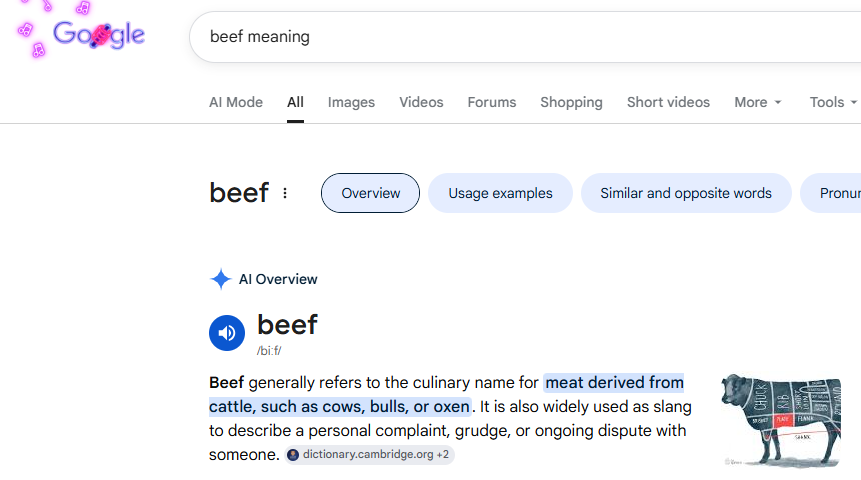
Search "beef meaning" on Google and here's what comes up:

"Beef generally refers to the culinary name for meat derived from cattle, such as cows, bulls, or oxen."
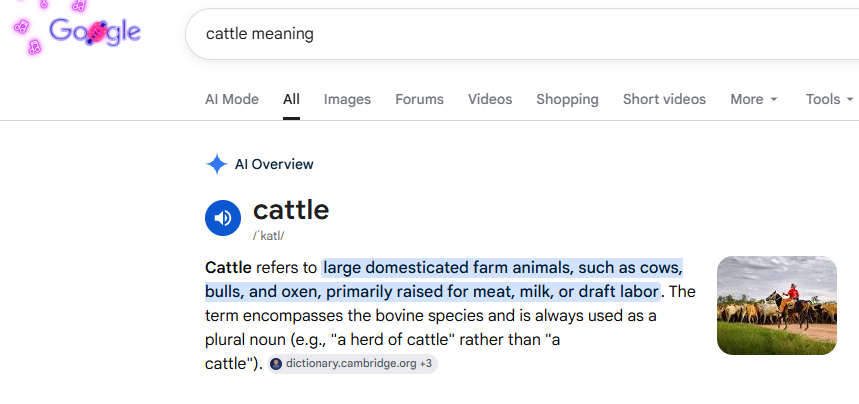
Now search "cattle meaning":

"Cattle refers to large domesticated farm animals, such as cows, bulls, and oxen, primarily raised for meat, milk, or draft labor."
So far, in English, "beef" = meat from cattle, and cattle = cows, bulls, oxen. Buffalo is a separate species (Bubalus bubalis) — it's not even technically cattle (Bos taurus / Bos indicus).
Now ask Google the same thing in Hindi
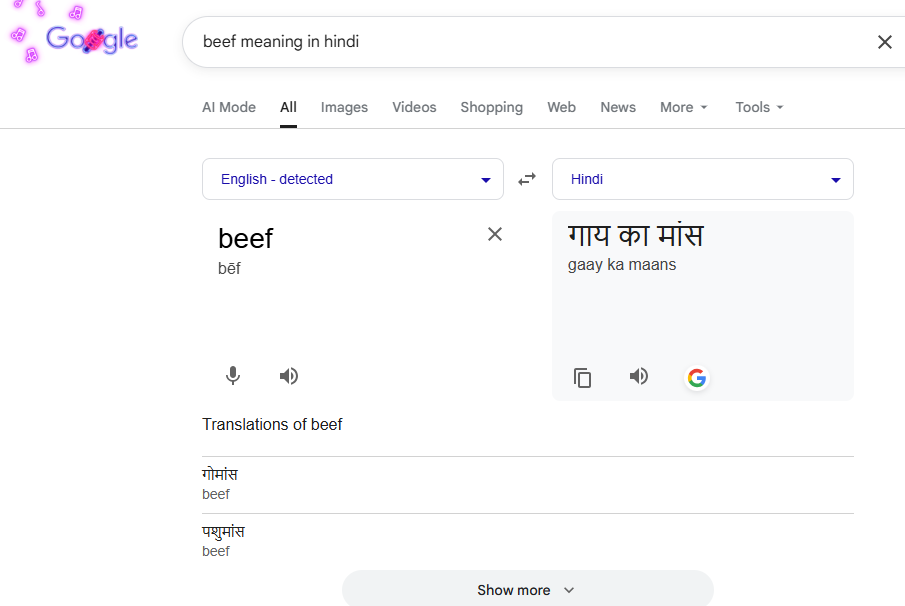
Here's where it gets interesting. Search "beef meaning in Hindi":

beef → गाय का मांस (gaay ka maans) — literally, "cow's meat."
That's it. No mention of buffalo. No mention of oxen. No mention of "cattle" as a broader category. The Hindi reader walks away thinking: beef = cow meat. Period.
So when an Indian newspaper translates a global headline as "भारत बीफ निर्यात में दुनिया में नंबर एक", the average Hindi reader hears: India is the world's #1 cow-meat exporter.
That's not what the English headline actually says. And it's not what India actually exports.
What India actually exports
Here's the part that almost never makes it into the headline:
- Cow slaughter is banned or heavily restricted in most Indian states.
- India's so-called "beef" exports are overwhelmingly carabeef — water buffalo meat. The official trade category at APEDA is literally called "Buffalo Meat."
- The USDA itself separates "buffalo meat" from "beef" in its India reports — but global headlines collapse them back together because in international trade classification, both fall under "bovine meat."
So the technically-true statement is: India is the world's largest exporter of bovine meat, almost all of which is buffalo, not cow.
The headline-friendly version — "India is the top beef exporter" — is true only if you stretch "beef" to mean "any bovine." Which English does. Which Hindi explicitly does not.
Where did all this buffalo meat come from?
This is the part most people miss. Rewind to around 2001.
India's monsoon patterns shifted. Rain crises started hitting cow-dependent dairy regions hard. Buffalo, being more drought-tolerant, producing more milk per animal, and surviving on lower-grade fodder, became the preferred dairy animal. Government and cooperatives pushed buffalo milk hard — and it worked. The buffalo population exploded over the next two decades.
But here's the thing about a buffalo: it lives 15 to 25 years, and it stops producing milk well before that. So roughly a decade after the buffalo boom started, a steady stream of post-productive buffalo started reaching the end of their dairy life — and many of those animals ended up at slaughterhouses, with the meat exported.
The "rise of India as a beef exporter" isn't a sudden cultural shift. It's the back-end of a dairy policy that started 20+ years ago.
So is this a word-game, or an agenda?
Honestly — probably both, in different proportions.
The word-game part is real and provable:
- English "beef" includes buffalo in trade contexts.
- Hindi "गाय का मांस" does not.
- Google's own translation tool reinforces the narrower Hindi meaning.
- Global trade statistics use the broader meaning.
That mismatch alone is enough to make the headline feel like a punch in the gut to anyone reading it in Hindi — even when the underlying export is buffalo meat that no Indian religious tradition prohibits.
The "agenda" part is harder to prove, and I'm not going to claim certainty here. But it's fair to ask: who benefits when India looks like a hypocritical mass cow-slaughterer to its own people? Beef-exporting competitors — the US, Brazil, Australia — certainly don't lose anything from that framing. Whether anyone is actively pushing the conflation or it's just lazy translation, the effect on Indian public opinion is the same.
The takeaway
Next time you see "India is the world's biggest beef exporter":
- Check whether the article distinguishes buffalo meat (carabeef) from cow meat. If it doesn't, it's already misleading you.
- Remember that the Hindi translation of "beef" — the one Google itself serves — is narrower than the English word the headline used.
- Look at the actual APEDA export category. It says Buffalo Meat. It has for years.
This isn't a defense of any slaughter — it's a defense of clear language. You can have an honest debate about buffalo exports, dairy-industry ethics, or animal welfare. But you can't have any of those debates honestly if half the room thinks the word means one thing and the other half thinks it means something else.
That's not journalism. That's a word-game. And in this case, India is the one losing it.