Red Sindhi Cow: The Resilient High-Yield Breed for Climate-Smart Dairy
Continuing our indigenous breed series, we dive deep into the Red Sindhi breed. Renowned for its rich A2 milk, high heat tolerance, and resistance to diseases.
Continuing our series on India's majestic indigenous cattle, we are focusing on one of the most resilient and high-yielding dairy breeds in the subcontinent: the Red Sindhi.
With climate change bringing hotter summers and unpredictable monsoon patterns across India, dairy farmers are increasingly moving away from delicate exotic breeds (like Holstein Friesian and Jersey) and turning to robust desi cows. The Red Sindhi is a perfect candidate for sustainable, climate-smart dairy farming.
Origin and Distribution
The Red Sindhi originated in the arid, semi-dry regions of Sindh (around Karachi and Hyderabad in present-day Pakistan). Because of its exceptional qualities, it was widely distributed across India during the early 20th century.
Today, pure Red Sindhi herds are maintained at state agricultural universities, organized gaushalas, and progressive dairy farms in Rajasthan, Gujarat, Punjab, Haryana, Tamil Nadu, and Uttar Pradesh.
Identifying a Red Sindhi Cow
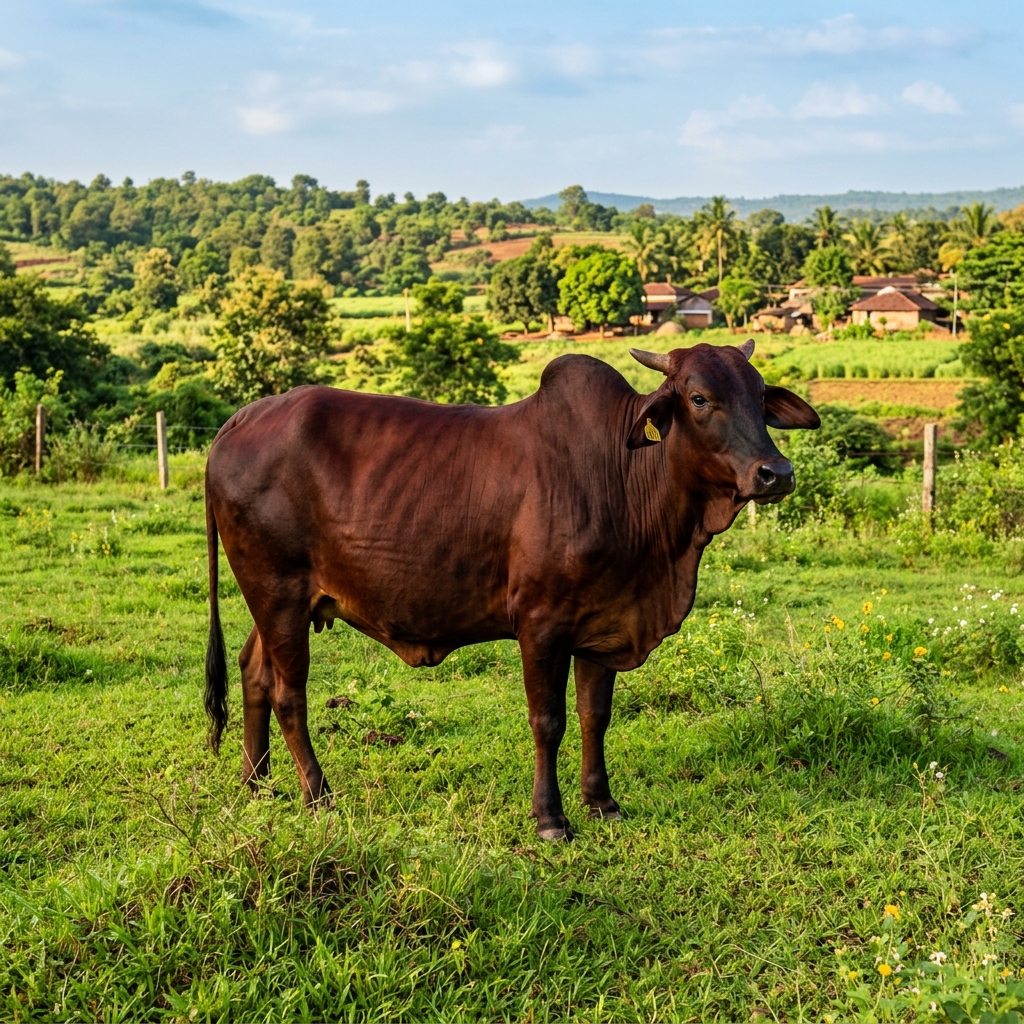
You can recognize a purebred Red Sindhi by these distinct physical traits:
- Coat Color: Deep, rich reddish-brown. The color is uniform, though bulls are often darker on the shoulders and face.
- Head: Broad forehead with a slight bulge, and medium-sized horns that emerge laterally and curve upwards.
- Build: Medium-sized, compact body with a well-developed dewlap and a moderate hump.
- Ears: Medium-sized, alert, and slightly drooping.
- Udder: Symmetrical, capacious, and well-attached, indicating excellent dairy capacity.
Milk Yield and Composition
The Red Sindhi is primarily a dairy breed (unlike dual-purpose breeds like Kankrej or Haryana):
- : A healthy Red Sindhi cow averages . Under elite farm management, yields can easily touch 20+ litres.