Loading Go-LX...
View Full Image
Stable Rajasthan A2 milk
Tharparkar Cow
थारपारकर
Also called: White Sindhi, Grey Sindhi, Thari
The dual-purpose desert breed — milk and draught from the dunes.
Native tract: Tharparkar district (Pakistan) and India's Jaisalmer, Barmer, Jodhpur
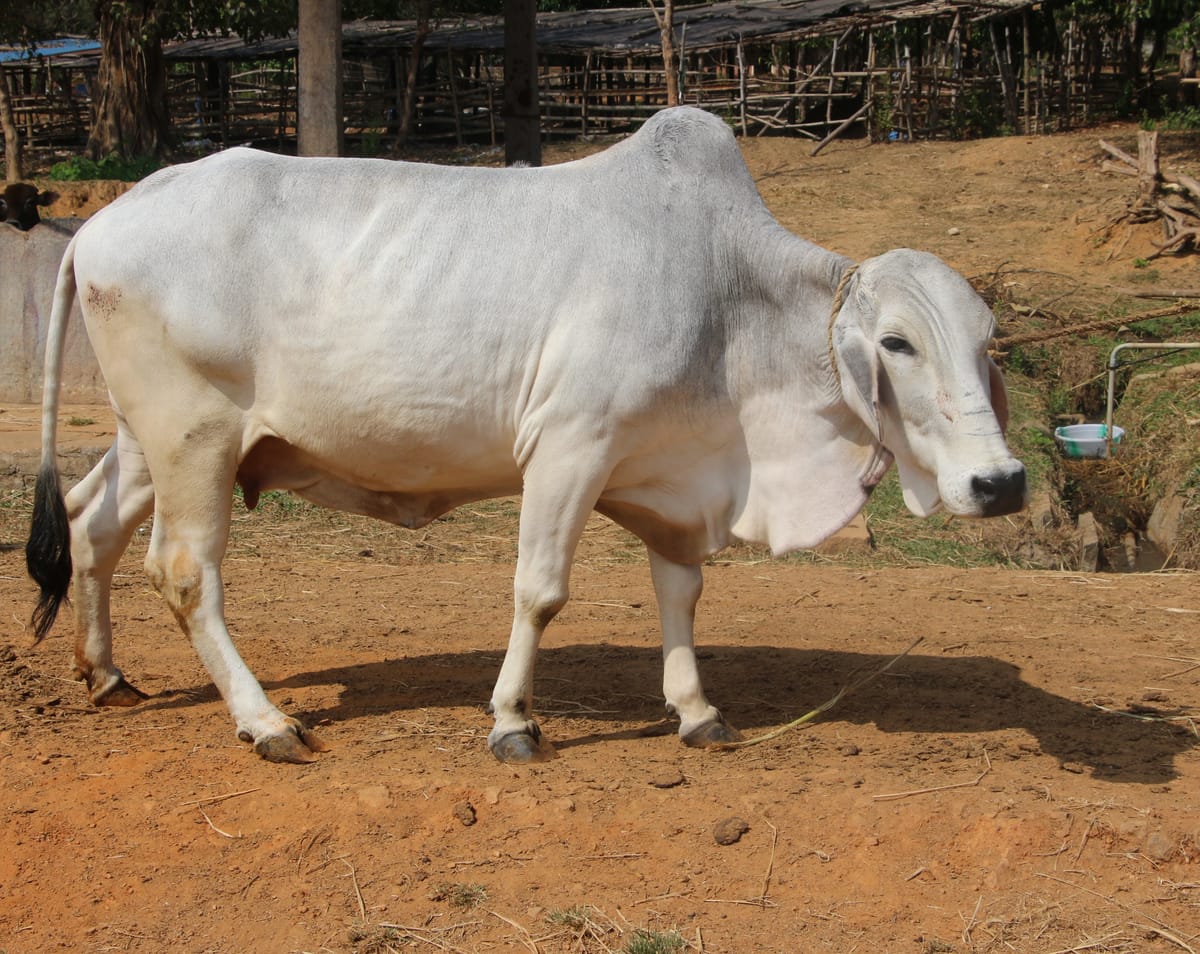
Photo: Wikimedia Commons contributors · CC BY-SA
Milk per day (peak)
7–10 L
Milk per lactation (~300 days)
1,400–3,000 L
Milk fat
4.5–5.0%
Adult weight
350–450 kg
Distinctive features
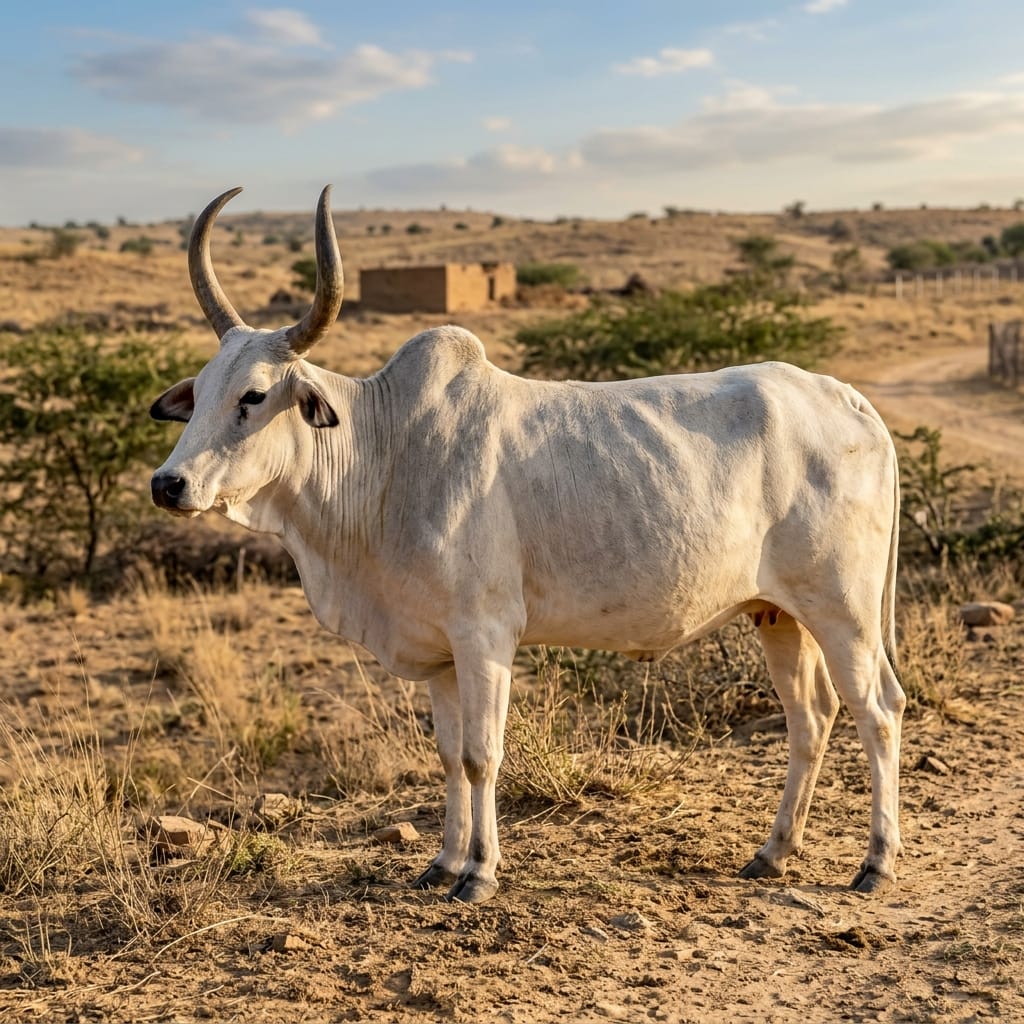
Coat: White or light grey; calves are red-brown and turn grey on maturity.
- Medium-sized, well-proportioned body
- Lyre-shaped horns curving outward and upward
- Hump moderate in size; dewlap thin
- Black skin pigmentation — protects against intense desert sun
Temperament & utility
- Survives on coarse fodder where other breeds starve
- Combines respectable milk yield with strong draught capacity
- Disease resistant; minimal incidence of mastitis
- A2 milk with excellent keeping quality in heat
History & lineage
Tharparkar evolved in the Thar desert, where Sindhi Hindu herders selected for a cow that could walk 15 km a day, survive on babul and ker pods, and still give the family's daily milk. The breed was famous in pre-Independence India as a "soldier breed" — used by the British Army for milk supply to garrisons. Today, government farms at Suratgarh and Pal continue the conservation work, and Tharparkar genes are widely used to upgrade dairy herds across arid India.
Why Tharparkar matters
Climate change makes the Tharparkar more relevant, not less. As Indian summers stretch longer and water grows scarcer, breeds that thrive on minimal inputs become the only viable dairy option for marginal farmers. Tharparkar is one of the few cows that can pay for itself in 60 cm rainfall zones.
Tharparkar cow price in India
Typical milking cow
₹45,000 – 1,00,000
Healthy, regular yield
Elite / registered lines
₹2,00,000 – 6,00,000
High yield, pedigreed
Tharparkar is undervalued relative to Gir/Sahiwal despite comparable yields — buy from Rajasthan breeders directly to skip middleman margins. Drought-belt provenance matters: cows from the Thar tract command a premium.
Monthly maintenance cost
Feed
₹3,000 – 5,000
Vet + vax
₹400 – 800
Approx. total
₹4,000 – 6,500
Tharparkar is the most water-efficient milking breed in India — designed for the desert. Maintenance cost drops sharply on dry-fodder + tree-leaf rations that would starve a HF.
A2 milk
Is Tharparkar cow milk A2?
Yes. Tharparkar produces A2 beta-casein milk by genetics — like all pure indigenous Indian (Bos indicus) breeds.
- A2 milk with 4.5–5.2% fat — comparable to Gir and Sahiwal.
- Lower somatic cell count than crossbreds because of strong mastitis resistance.
- Milk holds quality longer at room temperature — a real advantage in off-grid pastoral areas.
- A natural fit for India's A2 specialty market because the breed thrives without intensive infrastructure.
How to verify
Tharparkar is pure zebu — A2 by default. Verify pure-breed status visually: medium build, white-to-grey coat, lyre-shaped horns, deep barrel. Cross-checking with the seller's village against the Tharparkar tract (Barmer, Jaisalmer, Jodhpur, Sri Ganganagar) is the quickest authenticity screen.
Tharparkar vaccination schedule
Standard DAHD / ICAR schedule for indigenous Indian dairy cattle. Always confirm timing with your local vet.
| First dose | Vaccine | Cadence |
|---|
Compare Breeds
Select any two indigenous breeds to compare side-by-side.
| Feature | Tharparkar | Gir |
|---|---|---|
| Origin | Rajasthan | Gujarat |
| Daily Milk Yield | 7–10 L | 8–12 L |
| Lactation Yield | 1,400–3,000 L | 1,800–3,500 L |
| Milk Fat % | 4.5–5.0% | 4.5–5.0% |
| Adult Weight | 350–450 kg | 380–475 kg |
| Status | Stable | Stable |
| Coat Color | White or light grey; calves are red-brown and turn grey on maturity. | Glossy red or red-and-white pied; sometimes pure white. Reddish-yellow muzzle. |
| Milking Price | ₹45,000 – 1,00,000 | ₹50,000 – 1,20,000 |
| Maintenance | ₹4,000 – 6,500/mo | ₹4,500 – 7,000/mo |